
Enterprise SaaS · Web & Mobile
Role
Product Designer
Platform
Web & Mobile
Year
2022

Overview
AutoSmart Audit is an enterprise audit management platform built for automotive manufacturers, distributors, and dealership networks. It helps organizations digitize audits, monitor compliance, capture inspection evidence, and gain operational visibility across large-scale dealership networks.
When I joined the team, the product was already live and actively used by enterprise customers. Instead of designing a new product from scratch, my role was to evolve an established platform by improving usability, simplifying complex workflows, and making the experience more efficient without disrupting existing customer operations.
Over the course of the project, I redesigned most of the platform's core workflows, introduced the first dedicated mobile experience for field auditors, improved dashboard usability, and established a more consistent design language across the product.
The Business Context
Managing compliance across hundreds or even thousands of facilities is far more complex than completing digital checklists. Organizations need consistent audit standards, timely issue identification, evidence collection, and visibility into operational performance across distributed locations.
As the platform continued to grow, everyday usability challenges became more noticeable. Even small inefficiencies in frequently used workflows could have a significant operational impact when multiplied across thousands of audits.
The challenge wasn't to reinvent the product—it was to improve an enterprise platform already relied upon by real customers while preserving the workflows they depended on.
Where I Contributed
As the Product Designer, I was responsible for improving the overall product experience across desktop and mobile.
My responsibilities included
Product Challenges
Simplifying the Audit Experience
The audit workflow is the core of the entire platform.
The previous experience required users to process large amounts of information while performing inspections in active workshop environments.
The redesigned experience focused on creating a clearer and more structured journey
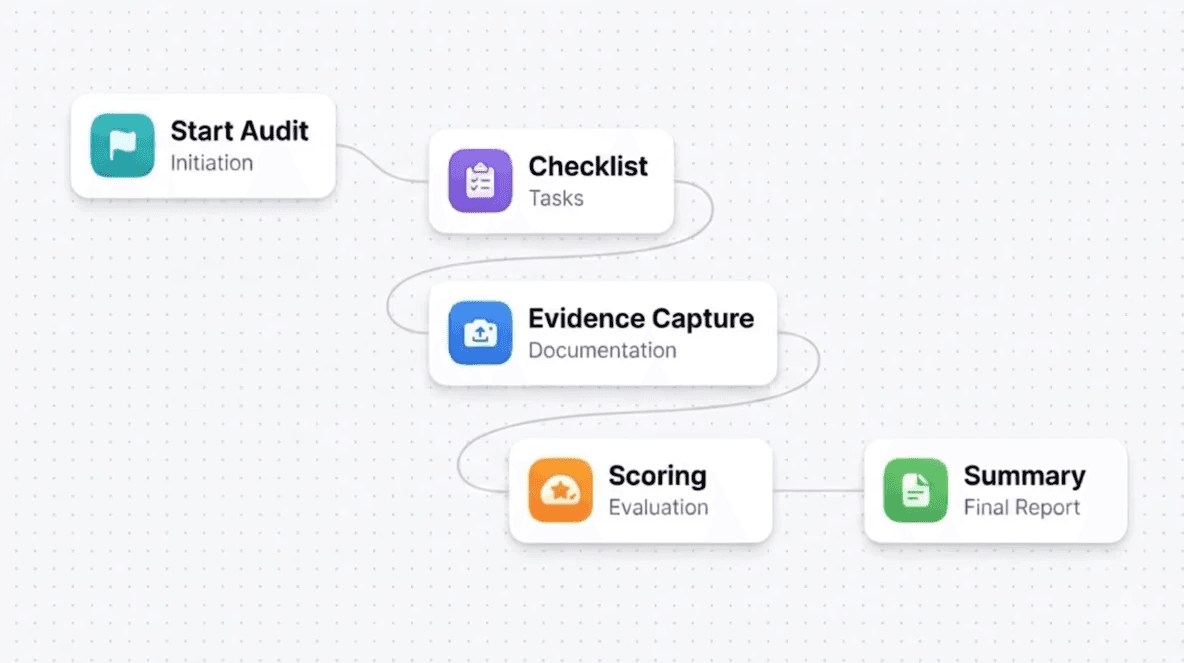
Instead of presenting large amounts of information at once, related tasks were grouped into logical sections that were easier to navigate.
Key improvements included:
Clearer task progression
Better organization of inspection sections
Reduced cognitive load during long audits
Improved navigation between audit stages
Better visibility of overall progress
The result was a workflow that supported the way auditors actually performed inspections rather than simply reflecting the underlying system structure.
Turning Data into Actionable Decisions
The original dashboard provided access to operational data but offered limited guidance on what required immediate attention.
The redesign shifted the dashboard from being primarily informational to becoming action-oriented.
Priority was given to surfacing:
High-risk findings
Pending audits
Compliance status
Critical actions requiring attention
Faster access to frequently used information
The original dashboard provided access to operational data but offered limited guidance on what required immediate attention.
The redesign shifted the dashboard from being primarily informational to becoming action-oriented.
Priority was given to surfacing:
Designing the First Mobile Experience
One of the most significant opportunities within the project was designing AutoSmart Audit's first dedicated mobile experience.
Before this redesign, field auditors relied on desktop layouts while performing inspections on mobile devices.
This created unnecessary friction during real-world audits where users were moving through service bays, capturing evidence, and completing inspections under time constraints.
The new mobile experience was designed specifically for field work.
Key improvements included:
Mobile-first layouts
Thumb-friendly interactions
Larger touch targets
Simplified evidence capture
Step-by-step audit navigation
Clear progress indicators for long inspections
Improved readability in field environments
Rather than adapting desktop screens, the mobile experience was designed around how auditors actually worked during live inspections.
Building a More Consistent Product
As the platform expanded, maintaining visual consistency became increasingly important.
The redesign introduced greater consistency across
Typography
Spacing
Color hierarchy
Form layouts
Navigation patterns
Interaction feedback
These improvements not only modernized the interface but also reduced the effort required to learn different areas of the platform.
Continuous Product Improvement
The redesign strengthened the overall product experience across desktop and mobile while supporting an enterprise platform already operating at scale.
Key outcomes included
The improvements supported a platform used by more than
1600+ automotive facilities worldwide.


Industry Recognition

What I Learned
This project fundamentally changed how I approach enterprise product design. Designing for operational software isn't about making interfaces look modern—it's about helping people complete critical tasks with confidence in demanding real-world environments. Working on an established enterprise platform taught me the importance of balancing user needs, business constraints, and existing customer workflows. Every design decision needed to improve usability without disrupting how organizations already operated.
It also reinforced a principle I continue to apply across every B2B SaaS product I design:
The best enterprise experiences don't simplify the business—they simplify how people interact with its complexity.